Background Information
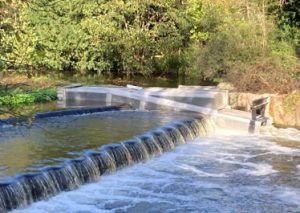
Becketswell Bridge crosses the Rivery Tiffey near Wymondham in Norfolk. The River Tiffey forms very important habitat. Being a chalk stream it supports a wide range of aquatic species. Aquamaintain were commissioned by Norfolk Rivers Trust to install a fish easement, removing one of the last remaining barriers to fish passage on the river.
Scope of the Project
The sill of Becketswell bridge was too high for fish to get over except in extreme floods, and even then, the power of the water is too strong for many species to swim over the obstruction. In recent monitoring, only 4 species of fish were found upstream of the bridge, whereas 8 species (dace, stoneloach, stickleback, eel, perch, minnow, bullhead and gudgeon) were recorded downstream. The aim was to increase the fish species’ composition above the bridge, but also reduce the risk of genetic isolation in the fish upstream, which can result in localised extinctions. Many species need to migrate to fulfil their lifecycle requirements, and if they’re unable to do so, they will inevitably decline.
Our Solution
The plan was to build a series of pools downstream, which will progressively raise the water level so that fish can make it up through each pool, and eventually over the bridge sill itself. The design was carefully modelled to ensure that raising the water level has no impacts on flood risk, or the integrity of the bridge itself. In addition, we worked closely with Anglian Water to check that the work did not impact a water main that crossed the river at the site. An important part of the design was to enable it to function in all flows e.g. drought and flood conditions, and it had to require low levels of maintenance. The design consisted of four baffles creating smaller steps incorporating notches to enable fish to pass over them. Crucially, the solution had to cater for all fish species. Therefore, eel tiles were installed against the piling alongside each baffle to allow elvers to move upstream. Aquamaintain Ltd developed the designs incorporating green Oak sleepers to construct the baffles from. These were buried into the riverbed and secured with rebar lengths driven through each baffle. The finished installation was dressed with fresh gravels and larger boulders to provide resting places for fish traversing the easement. The natural materials also helped improve the aesthetics of this popular site.